If you’ve ever invested, you know how challenging it can be (even if you don’t YOLO all your money into a single stock, lol). Thankfully, things get a lot easier when you build data-powered processes to guide your decision-making.
No wonder nearly half a trillion dollars are spent every year by financial firms on technology. Now, you probably don’t have that kind of money in the first place (and if you do, you don’t need to invest much anyway), but you might still want to collect financial data for personal use, research, academic projects, backtesting, or even just for selling it to industry giants.
No matter what you want to do with scraped financial data, there are a few pivotal tips to understand before embarking on this journey, which is exactly what I will explain here!
In this blog post, I will show why web scraping and finance are a match made in heaven and cover everything you need to know about retrieving both historical and real-time financial data from the web.
Web Scraping + Finance: A Happy Marriage
Before diving into web scraping for finance, let me explain why this is such a powerful approach and the advantages you can gain from it.
Finance Runs on (Web) Data
If there’s one thing that’s become clear over the past decade, it’s this: finance runs on data!
Financial institutions process massive volumes of market, customer, and transactional data every single day. In finance, data powers everything, from investment strategies to risk management. And the stakes are high, as bad data alone costs organizations an average of $12.9 million per year!
Data drives real-time decision-making, predictive modeling, and scenario planning. Finance teams feed that data into pipelines built around statistical analysis, machine learning, and AI to identify patterns, forecast market movements, and manage uncertainty in increasingly complex environments.
Now, here’s the central question we, web scraping enthusiasts, are all interested in: where does most of that data actually come from? A big portion of it comes from the web (not that surprising, uh?).
I’m talking about news sites, financial portals, company pages, official exchange websites, regulatory filings, institutional reports, and more. The web is essentially the largest and most dynamic data source available for financial purposes.
That’s exactly why web scraping in finance isn’t just useful. It’s foundational!
Before proceeding, let me thank NetNut, the platinum partner of the month. Their set of solutions cover all your needs for scraping.
Keep in mind that it’s not just big corporations or financial firms that benefit from data. Even individual retail investors can leverage financial data scraping to gain an edge. In particular, the main advantages include:
Informed decisions: Access to accurate historical data supports smarter investment decisions, while real-time data enables more solid trading choices.
Market trend insights: Spot patterns and emerging trends before the wider market does.
Risk management: Identify potential risks early and adjust strategies proactively.
Portfolio optimization: Fine-tune asset allocation based on backtesting and up-to-date market and company data.
Efficiency and speed: Automate data collection, reducing time spent on manual research.
I mean, financial firms wouldn’t be spending over $495 billion a year (yeah, you read that right!) on technology (mostly built around collecting, processing, and leveraging data) if it didn’t give them a real edge!
Getting vs Selling Financial Web Data: High-Level Overview
There’s no doubt that financial firms invest billions into data. But what about you, as a web scraping expert, how can you leverage financial data for potential gain? There are two high-level approaches:
For yourself or your company: Build custom web scraping pipelines to gather data from multiple sources. Use it to feed investment models, AI agents, trading algorithms, or analytics pipelines. This is usually highly tailored to your strategies, risk appetite, or operational goals.
To sell to financial services: Collect, aggregate, and potentially enrich data from various sources to sell. You can offer broad datasets for many clients or fully customized solutions for a specific customer’s needs.
For your scraping needs, having a reliable proxy provider like Decodo on your side improves the chances of success.
How to Approach Financial Data Scraping: Historical vs Real-Time
When it comes to finance, the web is packed with countless data fields and categories (e.g., news, stock prices, filings, analyst reports, and more). It’s a huge industry, and almost anything can be scraped!
At a high level, though, the key distinction for web scraping is simple: the financial data you want to collect is either historical or real-time. That’s what actually makes a difference in the approach to data scraping.
In the following chapters, I’ll dive deeper into each of the two categories of financial data. I’ll cover which fields are most interesting to scrape, where to find them, and how to collect them efficiently and effectively.
For now, start with a brief introduction to historical and real-time financial web data scraping!
Historical Financial Web Data
This includes all past financial data collected from the web, from historical stock prices to inflation rates and archived news. It’s used for analysis supporting long-term investment decisions.
👍 Pros:
Enables backtesting of investment and trading strategies.
Easier to scrape, as it isn’t time-sensitive.
Data itself is stable and doesn’t change over time…
👎 Cons:
…but the web pages displaying it (e.g., in tables and static charts) can still change, breaking your static parsing logic.
Misses recent market shifts or breaking events.
Data completeness varies across websites, often requiring aggregation from multiple sources.
Real-Time Financial Web Data
This includes live financial data extracted from the web, such as stock prices, market news, order books, etc. It’s employed for trading and short-term investment decisions.
👍 Pros:
Enables fast, data-driven trading decisions.
Captures live market movements and breaking news.
Can be passed to AI agents and pipelines directly, as it tends to require minimal preprocessing.
👎 Cons:
Harder to scrape reliably due to latency constraints and rate limits.
Requires robust infrastructure for real-time ingestion and analysis, as every second counts.
Data storage can grow rapidly because new data arrives continuously.
Mastering Historical Financial Data Scraping
As promised, let me guide you through the world of scraping historical financial data from the web.
Main Types of Historical Financial Web Data
The most important types of historical financial data you can retrieve from websites are:
Historical stock and commodity prices: Open, high, low, close (OHLC) prices and trading volumes for stocks, ETFs, indices, and commodities, used for time-series analysis, modeling, and predictions.
Summary info and infographics: Stock profiles, key metrics, and past indicators (e.g., P/E, EPS, moving averages), presented in dashboards or visual charts for quick insights.
Macroeconomic indicators: Inflation, GDP, interest rates, unemployment, CPI, and PCE data, essential for understanding economic cycles and long-term market behavior.
Financial statements: Company filings (income statements, balance sheets, cash flow), utilized for fundamental analysis and valuation models.
News data: Archived headlines and press releases analyzed via NLP to correlate past market movements with specific events and sentiment shifts.
ESG scores and sustainability reports: Historical environmental, social, and governance metrics employed to assess how “green” or ethical a company has been over time.
Alternative data: Non-traditional datasets like web traffic, social media, satellite imagery (e.g., new headquarters or production plants), or credit card data for early performance signals.
Most Popular Targets
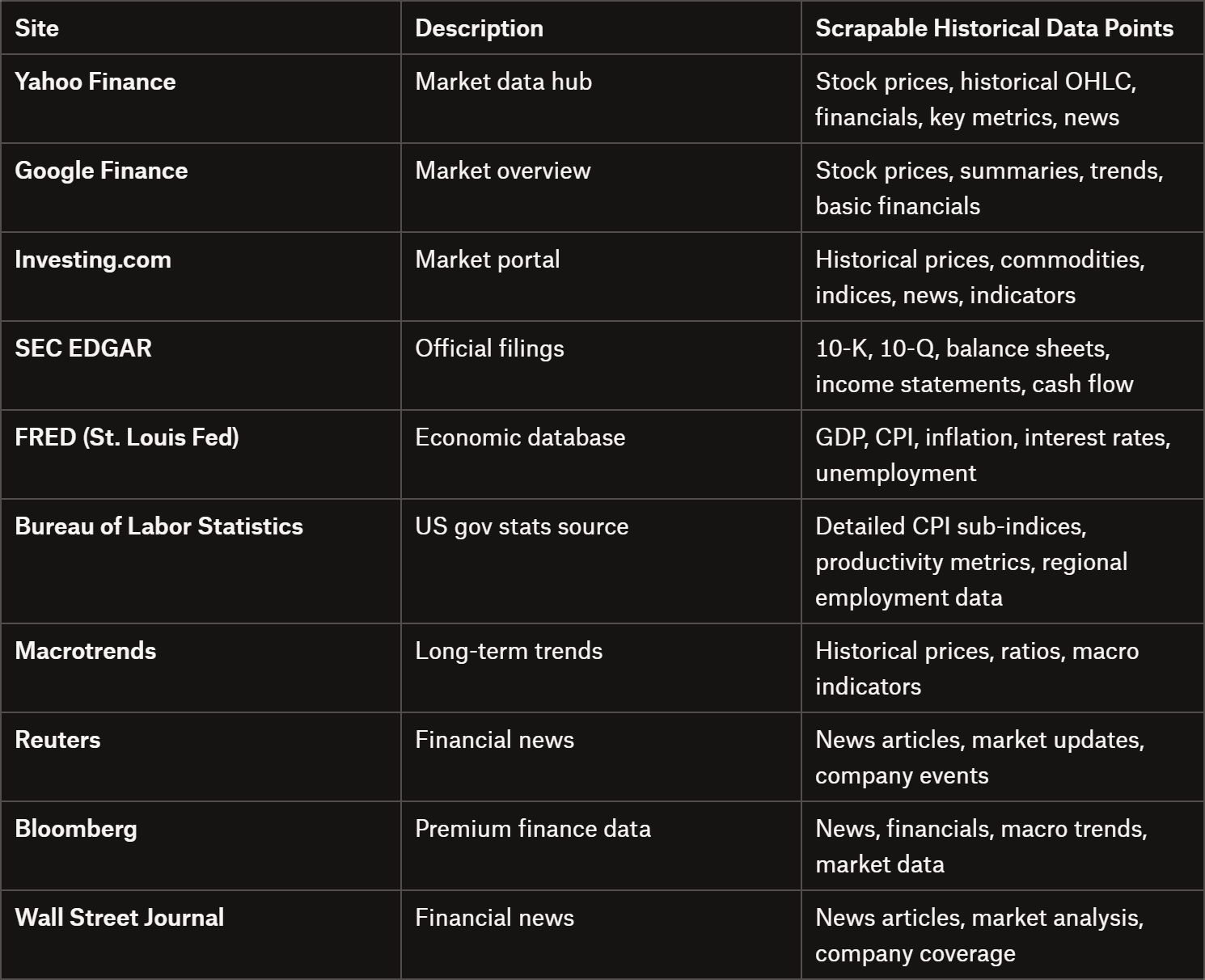
Popular historical financial data scraping sources
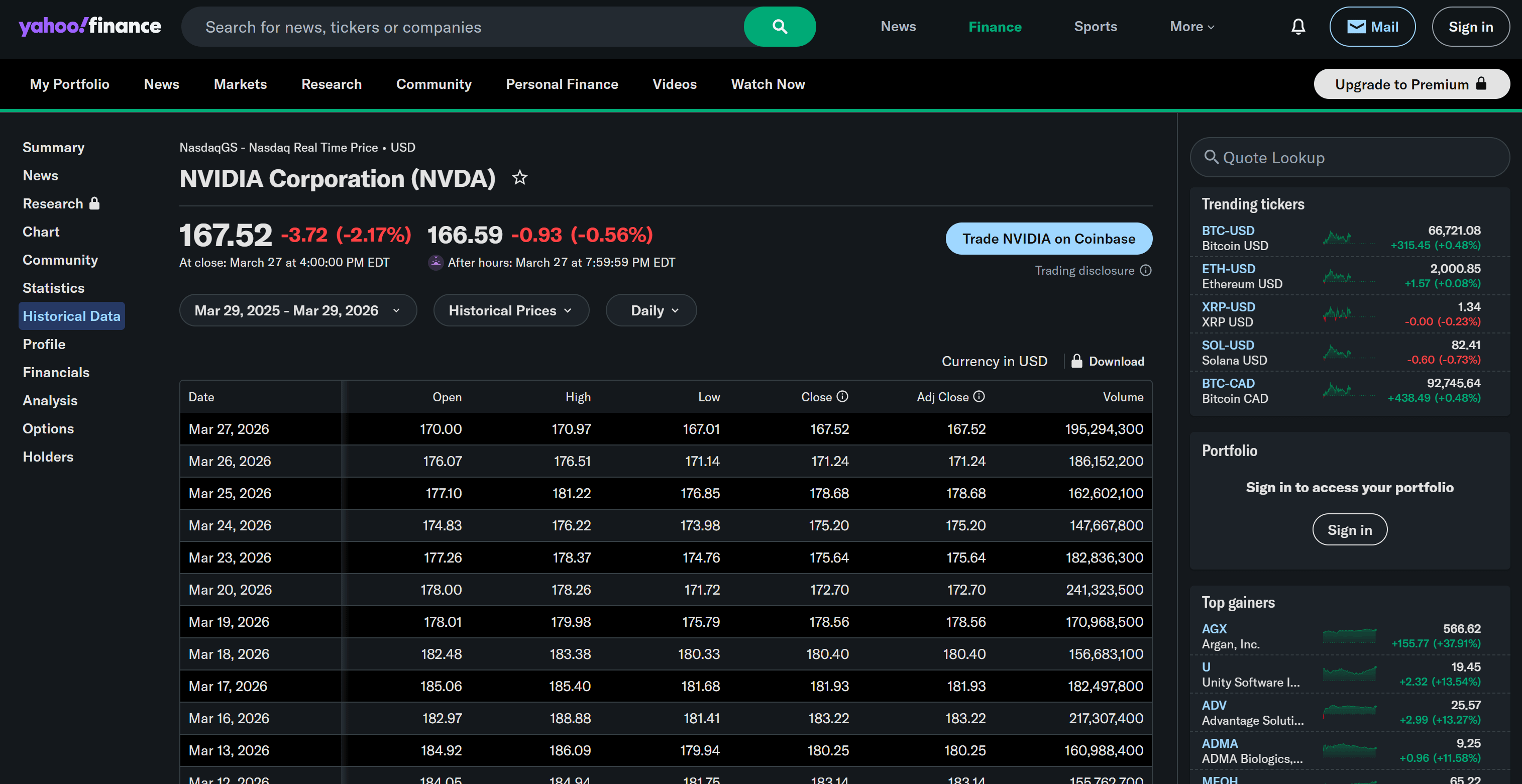
Typical examples of historical financial data include lists of open, high, low, and close prices for a given stock:
NVDA historical stock data (Source: Yahoo Finance)
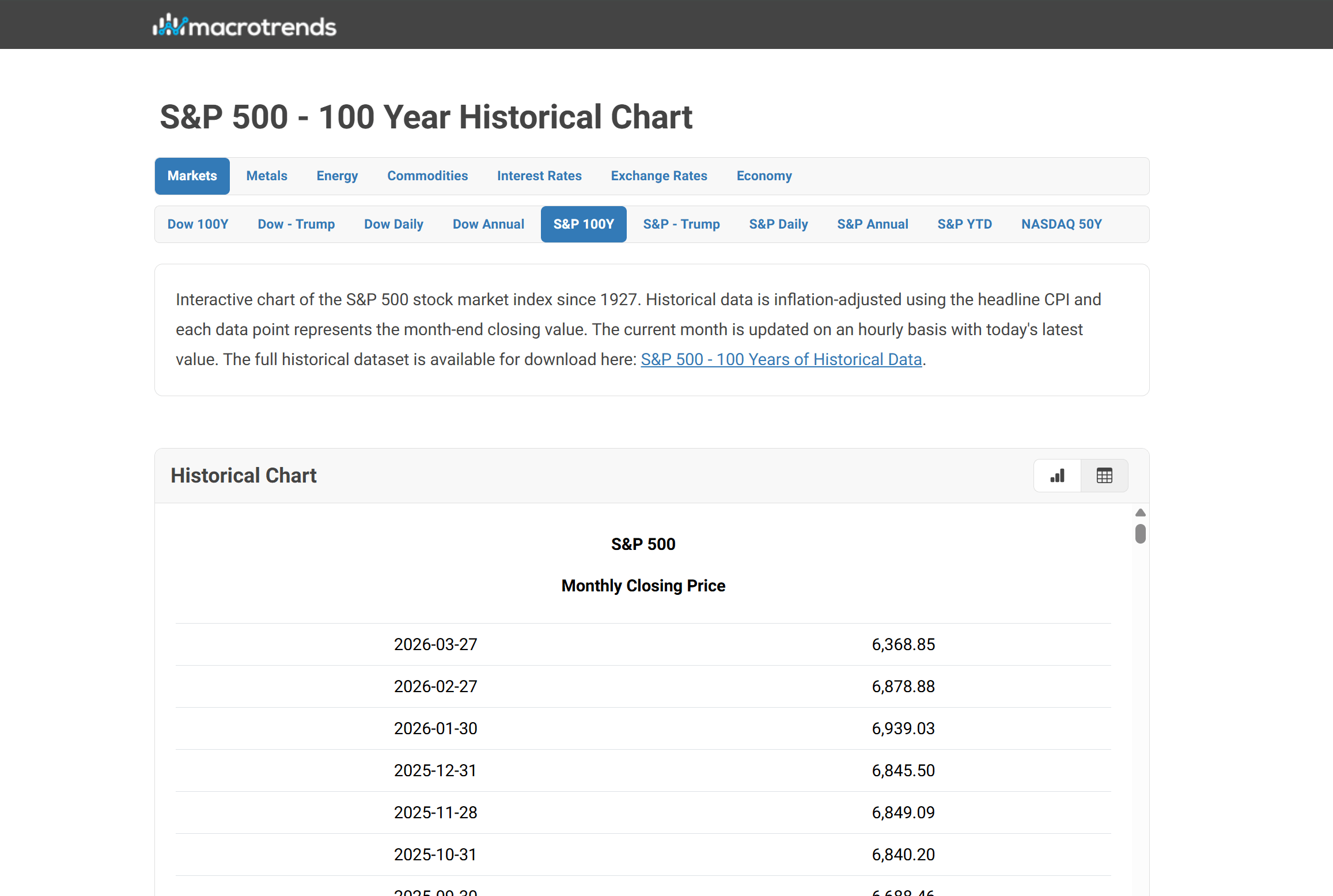
Or, another example, the historical returns of a specific index (.e.g, SP500) over time:
100-year monthly historical table for the S&P500 (Source: Macrotrends)
These cases fall into the category of table-based data scraping, one of the most common web scraping scenarios. You’re probably already familiar with it, so there’s no need to go too deep here. Scraping older news and media can be slightly more challenging due to the unstructured nature of the target data, but it’s still a simple task.
At a high level, the process for getting historical finance data via web scraping follows a standard workflow:
Visit the target web page, either via an HTTP client or a browser automation tool.
Parse the page using an HTML parser, either directly or after rendering in a controlled browser.
Select the HTML elements of interest and extract the data.
Store the scraped data in your desired format (e.g., XLS, CSV, JSON) or in a database.
The main challenges involve generic anti-scraping mechanisms, such as CAPTCHAs, WAFs, IP bans, as well as browser, TLS, and device fingerprinting.
Best Practices
Based on my experience with financial web scraping, especially when focusing on historical data, these are the tips you should apply:
Normalize and validate data: Standardize formats (dates, currencies, units) and validate across sources to catch inconsistencies early.
Be cautious with AI parsing: Avoid using AI for automatically parsing structured data (tables, metrics, structured fields). It can introduce subtle errors and hallucinations, so prefer deterministic parsing. Harness AI mainly for retrieving unstructured text like news.
This is where things get a bit more interesting. Let me introduce you to real-time financial scraping!
Main Types of Real-Time Financial Web Data
The most relevant types of real-time financial web data are:
Live price tickers: Continuously updated “last trade” prices and bid/ask spreads for stocks, crypto, and forex, used to detect breakouts and short-term trading opportunities.
Order book and market depth: Incoming buy/sell orders, liquidity levels, and spreads, fundamental for execution strategies and high-frequency trading.
Breaking news: Immediate updates and announcements that trigger sentiment models as soon as key figures (CEOs, central banks, governments) release information.
Corporate event triggers: Monitoring press releases or SEC feeds for earnings surprises, M&A rumors, or sudden executive changes.
Institutional “whale” activity: Observing large trades or major wallet movements (especially in crypto) to identify where significant capital is flowing.
Alternative digital signals: Web traffic spikes, app store ranking changes, or “out of stock” alerts on retail sites as proxies for real-world demand.
As you can tell, this category is more varied than historical financial data, including social media tracking and other less conventional practices. Thus, the sources to monitor for live financial web scraping can be less standardized and intuitive.
Most Popular Targets
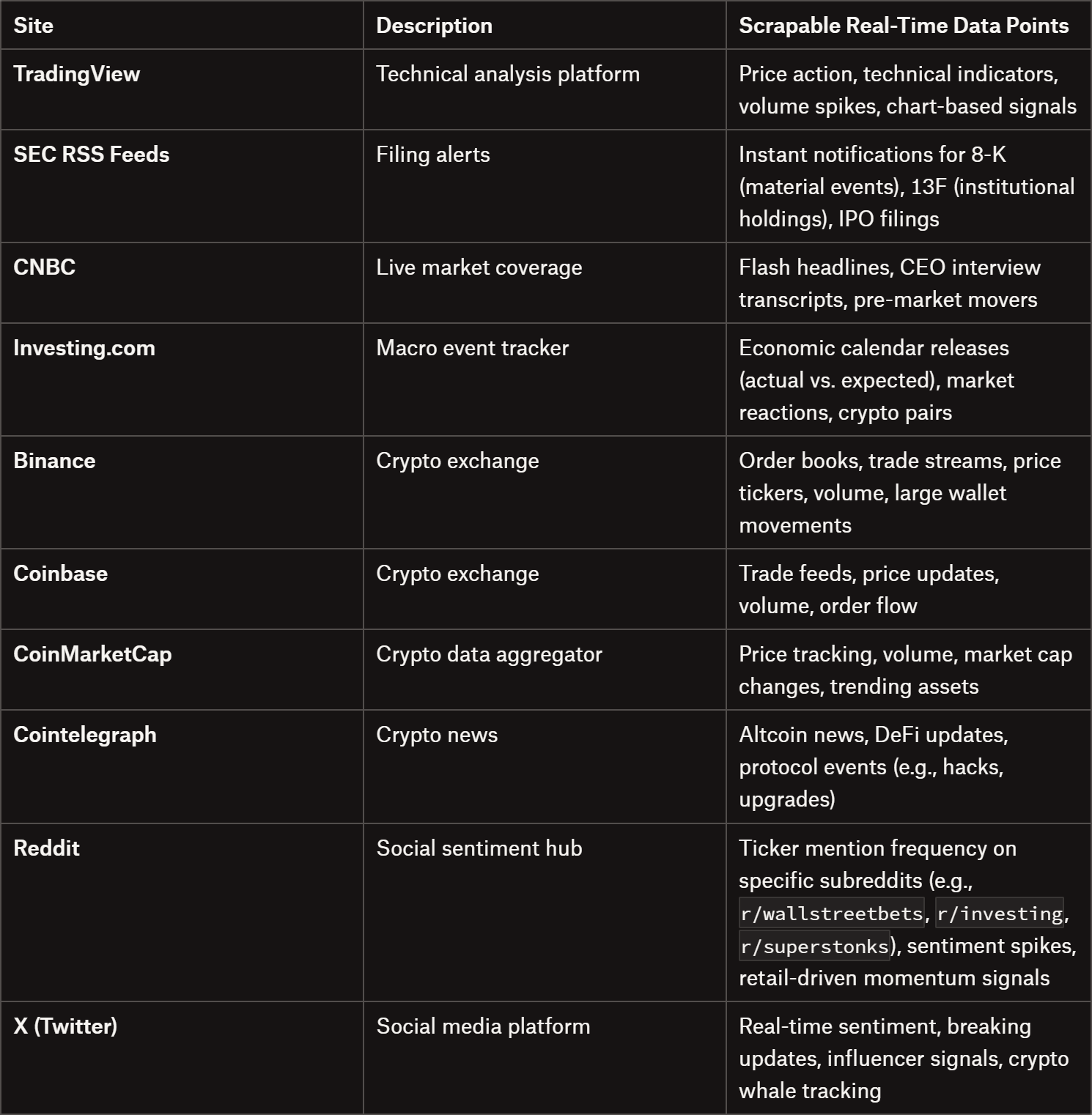
Popular live financial data scraping sources
Scraping Techniques
Imagine applying a traditional scraping pattern to real-time financial data. You send a request to a target site, extract a stock price, and repeat the operation every few seconds or even milliseconds.
The problem is latency. By the time the server responds, the page is rendered or parsed, the target data field is collected, and stored or sent to your pipeline, that piece of data is already outdated.
On top of that, this approach requires a crazy number of requests in a very short time. That increases the risk of triggering rate limiting or even IP bans. You might think proxies solve that through IP rotation, but most proxy networks introduce additional latency, often 2/3/5 seconds per request. In real-time scenarios, that delay is simply not acceptable!
Even if you switch to faster or dedicated proxies, you may end up with a smaller IP pool, which increases the likelihood of those IPs getting blocked.
A more advanced idea is to rely on browser automation and keep a page open, capturing updates as they happen. This is smarter, but still problematic. Long-lived sessions with little or no user interaction are highly suspicious and can easily trigger anti-bot systems. Plus, browser automation at scale tends to be flaky, not really reliable for persistent connections.
Long story short, scraping real-time financial data this way quickly turns into a losing game.
The solution? Stop targeting the data presentation layer in HTML and instead go directly to the data source!
API/WebSocket Scraping as The Solution
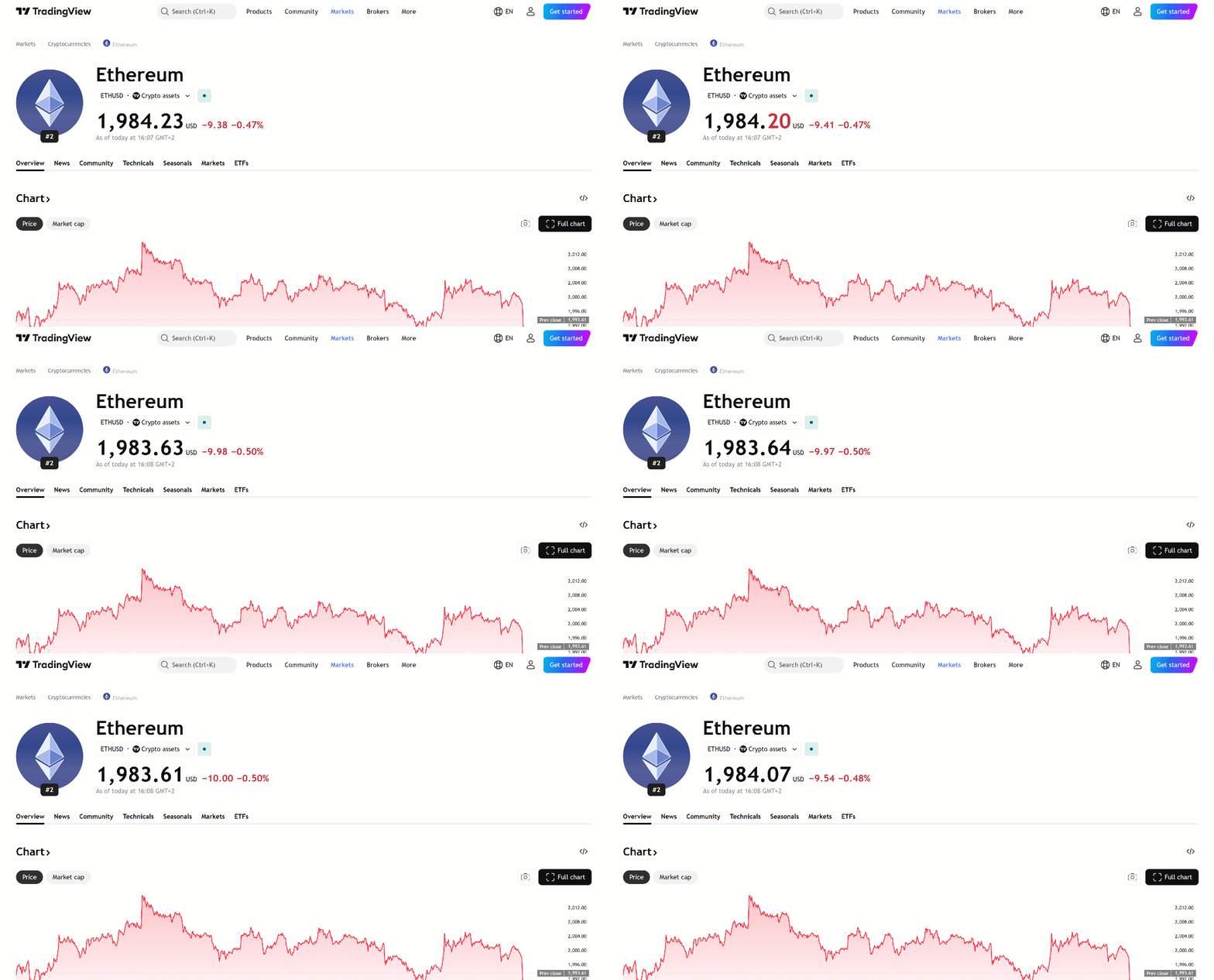
Web pages showing real-time financial data aren’t doing anything magical. Behind the scenes, they either poll APIs at regular intervals or (more commonly) maintain a persistent connection via WebSockets to receive continuous updates. The page simply renders that incoming data.
Note the live price update
As a result, a much better approach is to intercept and replicate those data flows. You can do this through AJAX/API request inspection or WebSocket sniffing. Open the browser developer tools, go to the “Network” tab, and check where the data is coming from.
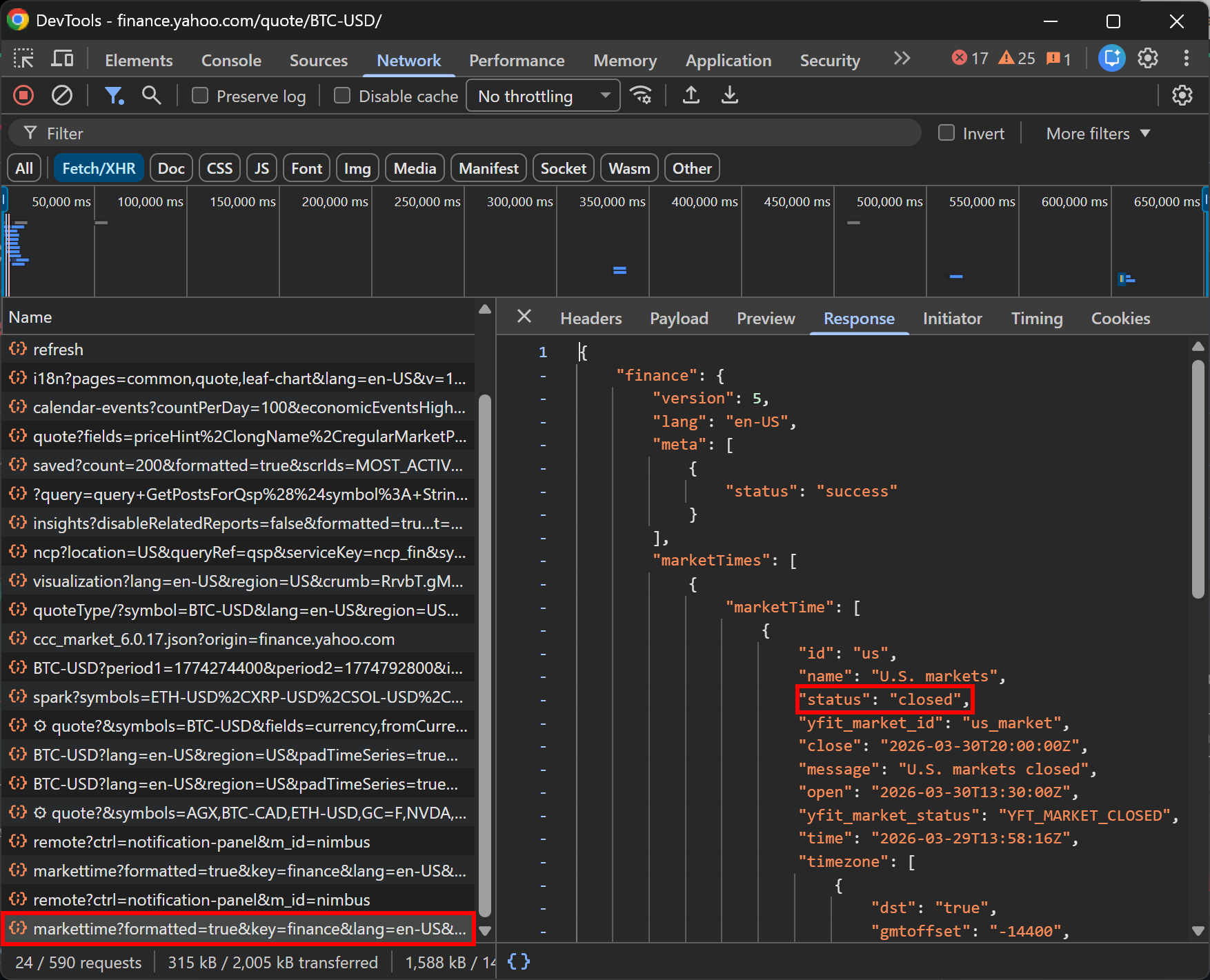
If it’s an API call, you’ll see it under the “Fetch/XHR” tab:
Note the API used by Yahoo Finance to determine whether the market is open in real time
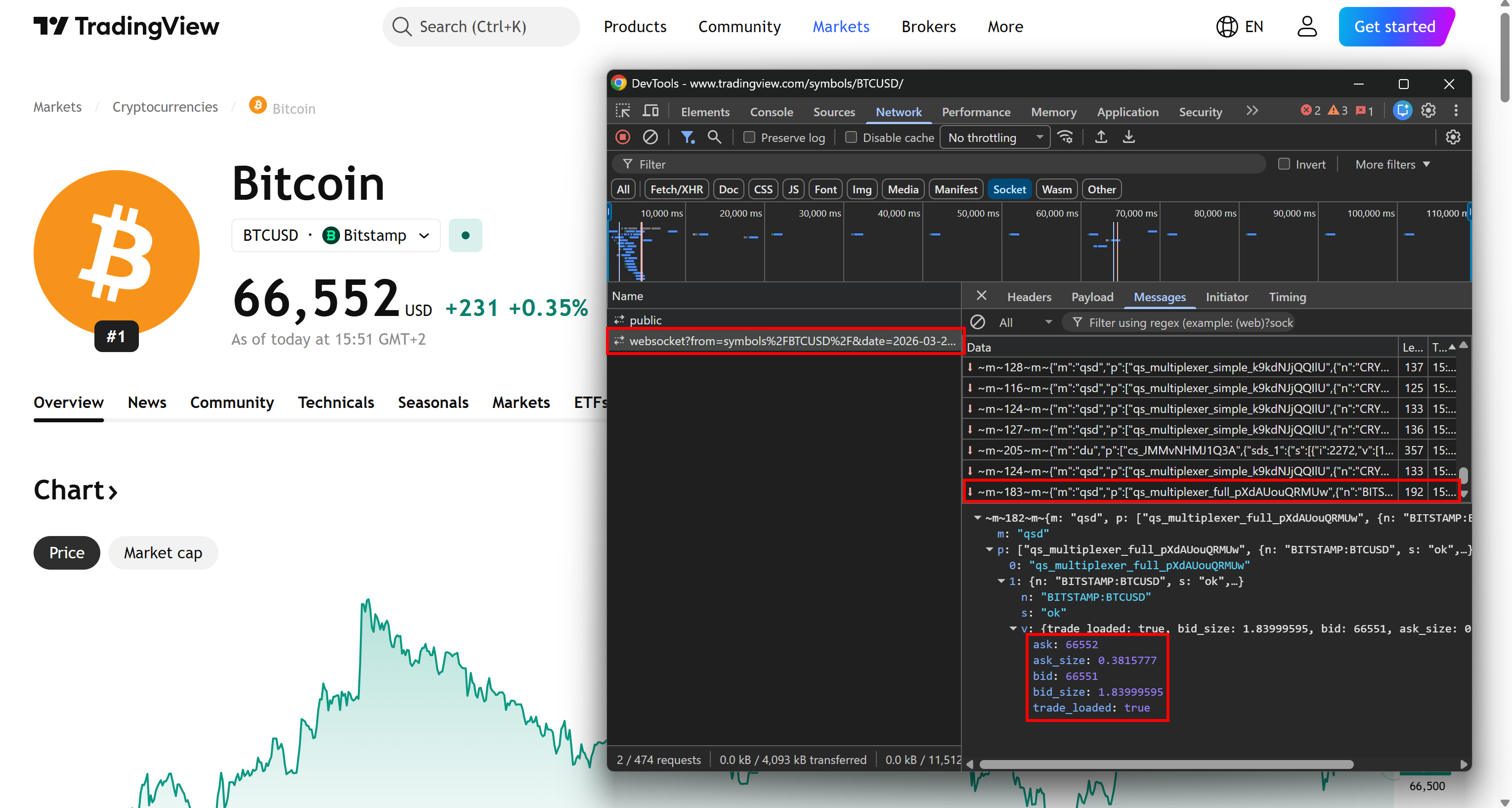
If it’s a WebSocket, you’ll find it under the “Socket” tab:
Note the live BTC price data retrieved from a message over a WebSocket connection established by the TradingView page
Once identified, replicate those API calls or connect directly to the WebSocket in your scraping script. This gives you access to near real-time financial data in a structured format (typically JSON) without the overhead of parsing HTML.
Of course, that’s not trivial. WebSockets require proper anti-bot bypass, and APIs may still enforce rate limits, tracking, and TLS fingerprinting protections. However, this approach is generally faster, more reliable, and much easier to maintain than scraping rendered pages!
And What About Live News or Social Media Scraping?
When it comes to news, if available, it makes sense to connect to public RSS feeds exposed by websites to monitor updates. This allows you to trigger scraping only when new and relevant content is published, instead of constantly polling pages unnecessarily.
Otherwise, you can build a polling mechanism that periodically checks news sites, social media platforms, and similar sources to capture fresh data. In these cases, you usually can’t rely on techniques like API or WebSocket scraping, as that’s not how those platforms fetch data.
Instead, you need a solid and robust infrastructure built around speed and efficiency: fast connections, high-quality proxies, optimized parsing, and lightweight requests. The goal is to minimize latency while maintaining reliability at scale.
Best Practices
Scraping real-time financial data is a demanding art, but it becomes easier with the following best practices:
Prefer APIs and WebSockets over HTML parsing: Whenever possible, save time by extracting data directly from the underlying APIs or WebSocket streams utilized by web pages instead of scraping data from rendered pages.
Choose clean, structured sources: Prioritize endpoints that return well-formatted JSON to minimize preprocessing and reduce latency.
Stream data into pipelines immediately: Send incoming data directly to processing pipelines for real-time insights, while storing it in parallel for later analysis.
Use specialized AI for sentiment analysis: Prefer AI/ML models tuned for finance/social media, as Reddit and X content often include slang, memes, and non-standard language.
Optimize browser automation: Configure Playwright, Selenium, or similar browser automation tools to block images, stylesheets, and fonts. This reduces bandwidth usage and significantly speeds up rendering time.
Design for low latency: Optimize your stack (async requests, streaming ingestion, fast JSON parsers) to minimize delays, as even milliseconds matter.
Time-synchronize everything: Append timestamps to all scraped data to enable time-series analysis and accurately reconstruct events.
Build fault-tolerant systems: Expect disconnections (especially with WebSockets) and issues, so add reconnection logic and configure fallback data sources.
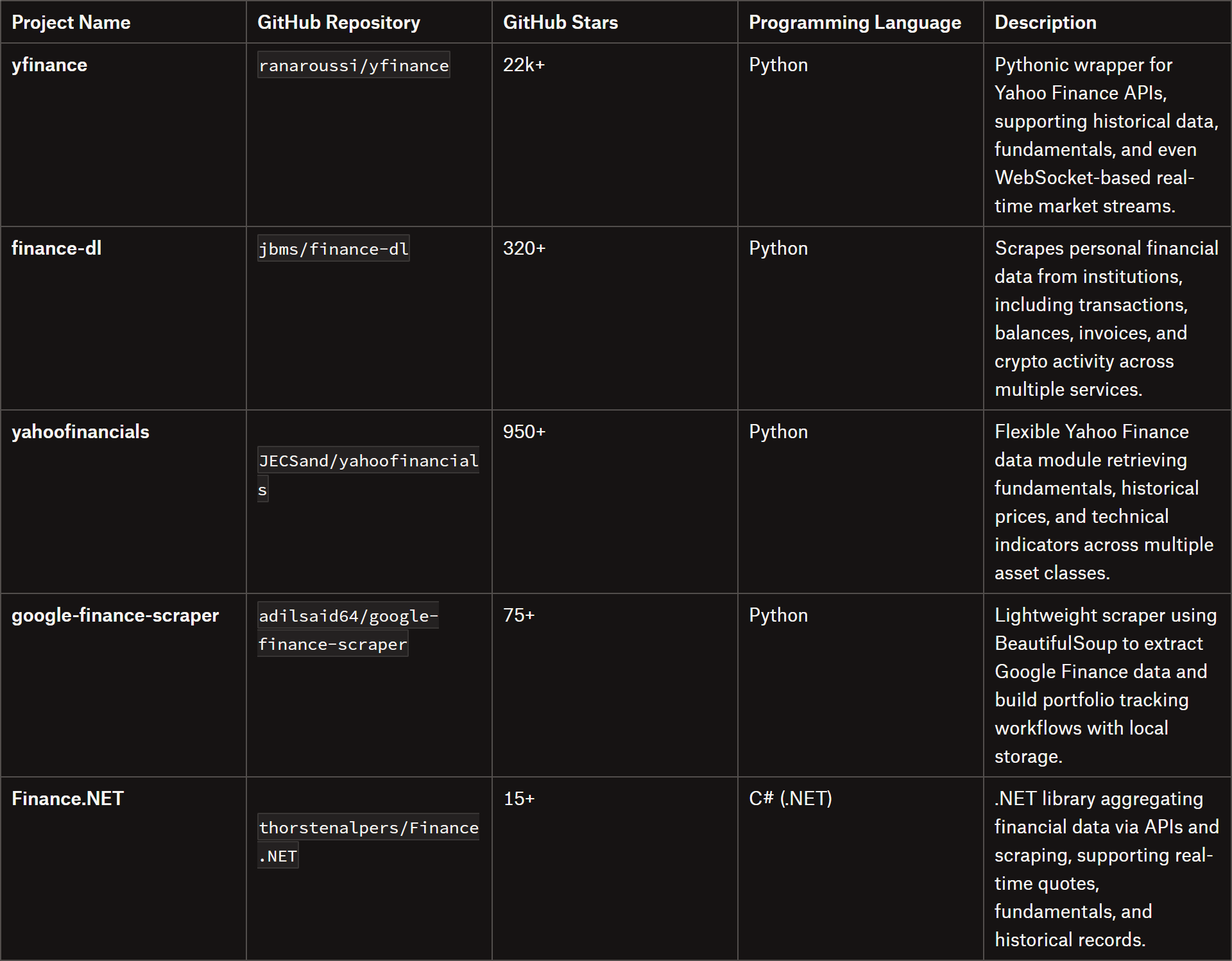
Top 5 Open-Source Financial Web Scraping Libraries
Below is a selected set of interesting, fully open-source libraries, packages, and projects for simplified financial web scraping:
Top open-source financial web scraping libraries
The Web Scraping Club is a reader-supported publication. To receive new posts and support my work, consider becoming a free or paid subscriber.
Conclusion
Here, I’ve gone through the rabbit hole of financial web scraping, the task of collecting finance-related data from the Internet. This is one of the main use cases of corporate web scraping, powering enterprise data pipelines for decision-making and market analysis.
As you’ve seen, the main difference in the approach comes down to whether you’re targeting historical or real-time data. The first follows standard web scraping practices you’re likely already familiar with. The second is trickier and requires more advanced techniques.
I hope you found this helpful and insightful. If you have questions, feel free to share them in the comments below!