Large language models have a memory problem, but it’s not in the conventional sense you may think of. The problem is that the knowledge baked into a model’s weights is static, bounded by its training cutoff, blind to proprietary data, and structurally incapable of being updated without retraining.
Retrieval Augmented Generation (RAG) was designed to solve exactly such limitations. By decoupling what the model knows from what it can access at query time, RAG gives LLMs the ability to reason over fresh, domain-specific, and proprietary knowledge without any retraining. In theory, this closes the knowledge gap entirely. In practice, the quality of a RAG system is bound entirely by the quality of its retrieval layer, and this is where most implementations break down.
Indeed, many teams think that the solution is already offered by web search tools that, nowadays, are integrated in all commercial LLMs. This article makes the case for why that is the wrong call and why web scraping is the right retrieval layer that RAG actually requires.
Let’s get into it!
Give your AI a web data layer – Decodo’s Web Scraping API turns any site into clean, structured data your models can actually use.
Retrieval Augmented Generation (RAG) is an architectural pattern in natural language processing that augments the inference pipeline of a generative large language model (LLM). It does so by dynamically injecting externally retrieved, contextually relevant information into the prompt at query time. In simple terms, rather than relying exclusively on knowledge encoded in model weights during training, RAG decouples parametric memory (what the model learned) from non-parametric memory (an external, queryable knowledge store), combining both at runtime. This produces models’ outputs that are accurate and grounded.
The canonical RAG pipeline operates in two distinct phases:
Retrieval phase: Given a user query q, a retriever component encodes q into a vector embedding database and performs approximate nearest-neighbor (ANN) search against a pre-indexed corpus of document chunks.
Generation phase: The retrieved passages are concatenated with the original query and injected into the LLM’s context window as an augmented prompt. The model, then, conditions its output token generation on both its parametric weights and the retrieved evidence, producing a response that is grounded in the supplied documents.
Modern RAG implementations have evolved beyond this baseline. Advanced RAG patterns introduce query rewriting, hypothetical document embeddings (HyDE), re-ranking layers, and recursive or agentic retrieval loops. Modular RAG frameworks further decompose the pipeline into interchangeable components, enabling fine-grained control over each retrieval and generation step.
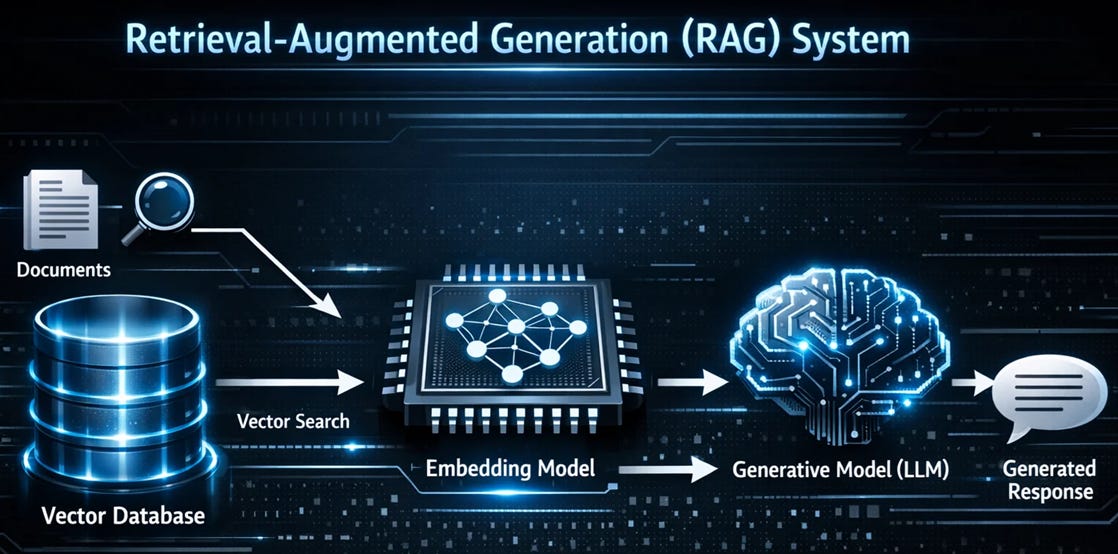
At the infrastructure level, modern RAG pipelines rely on three core components working in concert:
A vector database for storing and querying document embeddings at scale.
An embedding model responsible for encoding both documents and queries into a shared latent semantic space.
A generative model (the LLM) that synthesizes retrieved evidence into a coherent, task-specific response.
Below is an image that shows the high-level architecture:
A RAG system schema
Why LLMs Need RAG
During the training phase, an LLM compresses knowledge from its training corpus into billions of parameters. This process is inherently lossy because the model doesn’t store facts verbatim: it learns statistical associations between tokens. As a result of this process:
Factual recall is probabilistic, not deterministic: The model may confidently produce a plausible-sounding but incorrect answer on a user query, because it’s sampling from a learned distribution rather than retrieving from a verifiable source. The process of producing a plausible-sounding but incorrect response is called hallucination.
Knowledge is frozen at the training cutoff: Any event, document, regulation, product update, or research finding that postdates the model’s training window is entirely invisible to the model. For enterprise applications where data changes frequently, this is a critical failure mode. This means that if you query a model on something that occurred after its training ended, it will surely hallucinate the response.
Specific, private, or proprietary knowledge is absent by design: Internal documentation, CRM records, legal contracts, and domain-specific corpora are never part of a pre-training dataset.
RAG was designed precisely to address these constraints that are inherent to LLMs. Below is how RAG maps to concrete business scenarios that enterprises face every day.
Documentation-Aware Support Bots
One of the most immediate and impactful enterprise applications of RAG is the construction of intelligent support bots grounded in a product’s technical documentation. Consider a SaaS company with several pages of technical docs, API references, changelogs, and troubleshooting guides. An LLM cannot reliably answer user questions about that product. What happens is that it either lacks the knowledge entirely or, worse, generates plausible-but-wrong instructions that erode user trust.
With RAG, every user query triggers a retrieval step against the indexed documentation corpus. The bot responds based on what the docs actually say, not on what the model statistically associates with similar-sounding topics.
The same pattern extends naturally to internal knowledge bases like HR policy portals, IT helpdesks, onboarding assistants, and legal FAQ systems, where the source of truth is a controlled, company-owned corpus rather than the public web.
Legal and Regulatory Intelligence on Recent Developments
The legal industry represents one of the clearest demonstrations of RAG’s necessity. Why? Because court rulings, regulatory guidance, legislative amendments, and compliance frameworks are published continuously. Legal research on an LLM is inherently dangerous because its training cutoff means the model is blind to any case law or regulation published after that date. And, in law, a single overlooked precedent can have material consequences.
RAG enables a fundamentally different architecture: legal documents, newly published court opinions, and regulatory updates are scraped, processed, and indexed into the retrieval layer as soon as they are available. When a lawyer or compliance officer queries the system, the retriever fetches the latest relevant documents, and the LLM synthesizes a grounded answer.
Competitive Intelligence and Market Monitoring
Enterprises routinely need to track competitor activity, industry trends, and market signals across news sources, press releases, job postings, and public filings. This information is inherently ephemeral because a competitor’s product launch announcement published yesterday is invisible to any LLM. By building a RAG pipeline that continuously ingests and indexes targeted public web sources, organizations can deploy analysts-in-the-loop systems that answer strategic queries based on fresh, real-world evidence rather than stale parametric knowledge.
Why Web Search Integration Is Not Enough
On the side of the architecture, the retrieval part of RAG systems can be built in different ways. The common ones are two:
Creating a knowledge base of documents (like a plethora of PDFs and similar).
Retrieving the needed information from the live web.
The knowledge base of documents is generally something that companies have already built over the years. So, let’s focus on the web retrieval part—which is also the most interesting one for us, scraping professionals.
Today, every commercial LLM has a web search tool integrated into it. So, at first glance, it seems to be the right tool to use for creating RAG systems. After all, if the model can query the live web, doesn’t that solve the knowledge cutoff problem entirely? The answer is: partially, and only for a narrow subset of enterprise needs. This is because the web search integration and RAG are fundamentally different mechanisms that solve different problems. Below are the main differences between the two:
Web search operates on public web content: First of all, a web search tool cannot reach your internal knowledge base, your proprietary documentation, your CRM history, or your company’s legal contracts. Sure, some companies put their internal knowledge on the web with restricted access, but this encompasses only a few cases. Also, the truth is that no company actually puts all its documentation on a website, even if with restricted access (think of legal contracts, for example).
Web search is non-deterministic and uncontrolled by design: When an LLM issues a search query, the results it retrieves depend on the search engine’s ranking algorithm, which is commercially influenced and optimized for general web traffic, not for your specific domain. In a RAG system, instead, you control the corpus. In other words, you decide what documents are indexed, how they are chunked, how they are weighted, and when they are refreshed. This level of governance is not optional in regulated industries where compliance is a requirement. Indeed, an enterprise cannot defend an AI-generated legal or financial output that was grounded in whatever Google happened to rank first. Also, no one guarantees that the web search is actually able to read the content on a website that is highly protected. In other words, very often happens that the web search tool can’t overcome the anti-bot systems on a target website, and the model simply hallucinates the response to your query (and you don’t even notice!).
The retrieval mechanism itself is categorically different: Web search tools rely on keyword-based and PageRank-style relevance signals. RAG retrieval, by contrast, operates in a dense semantic vector space. This means that it finds documents that are conceptually relevant to a query even when they share no exact keywords with it. For domain-specific queries, this distinction in retrieval precision directly impacts the quality of the generated response.
Web search tools introduce latency, rate limits, and external dependencies: A RAG system backed by an internal vector store is a self-contained, auditable, scalable infrastructure component. A system that depends on a web search tool at every call is coupled to external services, subject to availability failures, and difficult to reproduce or audit
Web search tools don’t solve the hallucination problem: Web search tools increase the probability that relevant information surfaces in the context window, but if the search query is poorly formed, if the right page isn’t indexed, or if the model misreads the retrieved snippet, hallucination remains entirely possible. RAG, when implemented with rigorous chunking strategies, high-quality embeddings, and re-ranking layers, provides a far more controlled and reliable grounding mechanism.
In short, web search tools make general-purpose LLMs more useful for casual queries. This means that an LLM equipped with a web search tool is useful to respond to basic queries that rely on data recently published on the web. However, they can’t replace RAG systems for any organization that requires precision, privacy, control, and auditability over wide and specific knowledge.
Web Scraping as the Data Acquisition Layer for RAG
The limitations of web search tools presented in the previous paragraph are structural. The solution to overcome them is to use web scraping as the retrieval layer for your RAG pipelines. This is because by using web scraping, you are not querying an external search engine and accepting whatever it returns. You get direct, programmatic access to the content of any publicly accessible web page, on your own schedule, under your own control.
So, let’s see how scraping the web changes the dynamic of retrieving content from the web for RAG purposes.
Full Control Over the Knowledge Corpus
When you build a RAG pipeline fed by a web scraper, you are the one defining the boundaries of your knowledge base. You decide which domains, subdomains, and URL patterns are in scope. You decide how frequently each source is re-crawled, which pages are included, which are filtered out, and which are prioritized during indexing. None of this is possible with web search integration, where the retrieval scope is, by definition, the entire public web as ranked by an opaque external algorithm.
This level of corpus governance is a prerequisite for any enterprise deployment where the knowledge base must be auditable, bounded, and defensible.
Also, using web scraping as the retrieval layer doesn’t mean that you have to code and manage your own scraping infrastructure—which could cause overheads as well as a huge amount of investments. The scraping industry today is mature enough to offer you:
Pre-scraped datasets whose data can be refreshed based on your needs.
Scraping infrastructure as-a-service. In other words, you tell the provider the content to scrape, and their professionals do the job for you, providing you with ready-for-analytics data.
Accessing Content That Search Engines Cannot Deliver
Public search engines index a fraction of the publicly accessible web, and they do so on their own timeline and according to their own crawl priorities. Pages that were published recently, that exist on domains with low authority, that are dynamically rendered via JavaScript, or that are structured in ways that resist standard crawling are routinely underrepresented or absent from search engine indexes entirely.
A purpose-built web scraper is not subject to any of these constraints. It can be engineered to handle JavaScript-rendered single-page applications using headless browser automation tools such as Playwright or Puppeteer, capturing the fully hydrated DOM rather than the bare HTML shell that a naive HTTP request would return. It can navigate paginated content, follow internal links recursively to achieve full site coverage, and process non-HTML formats.
Now, you can also think that a plausible solution is to put a target URL into the prompt and ask the LLM to retrieve the content via the web search tool. But due to the nature of the web search tool, this is not a reliable solution, because, as discussed previously:
The web search tool may not be able to retrieve the content if the domain is highly protected by anti-bots.
The use of a web search tool is non-deterministic due to how LLMs work. This means that the LLM can respond without actually retrieving the content. Or, in some cases, the LLM can respond, but its response can be a mix of content retrieved from the target URL and other content that the web search tool has retrieved from the web. In other words, the LLM can autonomously decide to retrieve the content, for a given query, from the target URL you passed into the prompt, and from other content that the web search tool retrieves from the web, based on the query.
But for RAG pipelines that need comprehensive, deep coverage of a specific web domain, the right degree of control over the crawling behavior is a fundamental feature, often a non-negotiable one.
One of the most underappreciated properties of a scraping-fed RAG system is reproducibility. When a user queries a RAG system backed by a web-scraped and version-controlled vector store, the retrieval behavior is deterministic: the same query against the same index returns the same results. This makes the system testable, debuggable, and auditable in ways that a live-search-grounded system categorically is not.
In a search-integrated LLM, the retrieved content is ephemeral. Specifically speaking, the content exists only in the context window of a single inference call. This means that it cannot be logged in a structured way, and may differ entirely if the same query is issued five minutes later because the search ranking shifted. In a scraping-fed RAG system, instead, every document in the index has a known origin, a known ingestion timestamp, and a known embedding. If an output is questioned, you can trace it back to the exact chunk, the exact source page, and the exact crawl that produced it. This traceability is the operational backbone of trustworthy enterprise AI.
Freshness on Your Terms
The knowledge cutoff problem that cripples base LLMs does not disappear with a static RAG corpus. A vector store that was indexed six months ago and never refreshed is, from a knowledge currency standpoint, equivalent to a model with a six-month-old training cutoff. Web scraping solves this by makingfreshness a configurable, automated pipeline.
A production RAG scraping pipeline typically implements a tiered crawl schedule calibrated to the update frequency of each source: high-volatility sources like breaking news feeds, regulatory update pages, earnings release portals, and product changelog endpoints are re-crawled on a schedule ranging from hourly to daily. Lower-volatility sources may be re-crawled weekly or triggered by change detection signals. When new content is detected, only the affected chunks are re-embedded and re-indexed, making incremental updates computationally efficient even at scale.
This architecture gives enterprises something that neither a base LLM nor a search-integrated model can offer: a knowledge base with a freshness SLA. This is a contractual guarantee that the information grounding the system’s outputs is no older than a defined threshold.
This matters enormously for chunking quality, and by extension, for retrieval quality. Recall that the integrity of every chunk is bounded by the integrity of the raw text it was derived from. A scraper that faithfully extracts clean, well-structured prose gives the downstream chunker the structural signals it needs to produce semantically coherent chunks. A scraper that emits raw HTML soup, or that fails to distinguish between primary content and navigational boilerplate, contaminates the entire corpus with noise that no chunking strategy can fully recover from.
Furthermore, this is another point of distinction with web search tools. In another article here at the web scraping club, we already covered the importance of feeding LLMs in markdown, rather than in HTML. Based on this, consider that:
Every scraping pipeline can be managed to return data in any format you prefer. It can be a structured JSON, markdown, or anything else.
Web search tools go directly to “read” the HTML of the target web pages. This means that the LLM responds based also on footers, banners, and anything in between. And this can lead the model to confusion as it responds to users’ queries.
The Web Scraping Club is a reader-supported publication. To receive new posts and support my work, consider becoming a free or paid subscriber.
Conclusion
RAG is an architectural commitment and, as such, it must be preceded by a deliberate choice to build a system where outputs are grounded in a controlled and continuously refreshed knowledge base. But that commitment is only as strong as the pipeline feeding it.
Web search integration tools are not that pipeline. This is because they are optimized for general-purpose queries, not for the precision, governance, and reproducibility that enterprises demand.
Web scraping, on the other hand, gives you full ownership over what enters the knowledge base, how fresh it is, how it is structured, and how it can be traced back when an output is questioned.
The next step is to start thinking of your scraping infrastructure not as a standalone data collection tool, but as the retrieval backbone of an intelligent system.
So, let us know in the comments: are you using web scraping for RAG purposes?
Did you like this article? Share it with someone who might find it useful and get a discount on paid plans.