Residential proxy networks are facing a hard time. After the IPIDEA case, the FBI targeted NetNut, one of the biggest names in the industry, and seized their domain netnut.io, proxyjet.io (subsidiary company), and divinetworks.com (partner network for IP sourcing). The suspicion is that their residential proxy network was used for fraudulent operations.
I’ve worked closely with NetNut, and I don’t think they’re directly involved in anything: it’s a public company, there’s no need to put their network at a fraudster’s disposal. But some pieces of the KYC procedures and auditing were probably missing, given that they also had a network of resellers which are harder to control.
This crusade against residential proxy networks probably will lead to major shifts in the next months (ready to be contradicted).
Less supply, higher demand: higher prices and/or worse quality. At least for residential proxies, the price run to the bottom will stop. With demand growing and fueled by AI needs and less supply of IPs, more requests will transit through the same addresses, degrading quality. More providers will try to avoid this by charging more for premium-quality addresses (read: addresses with fewer requests on them).
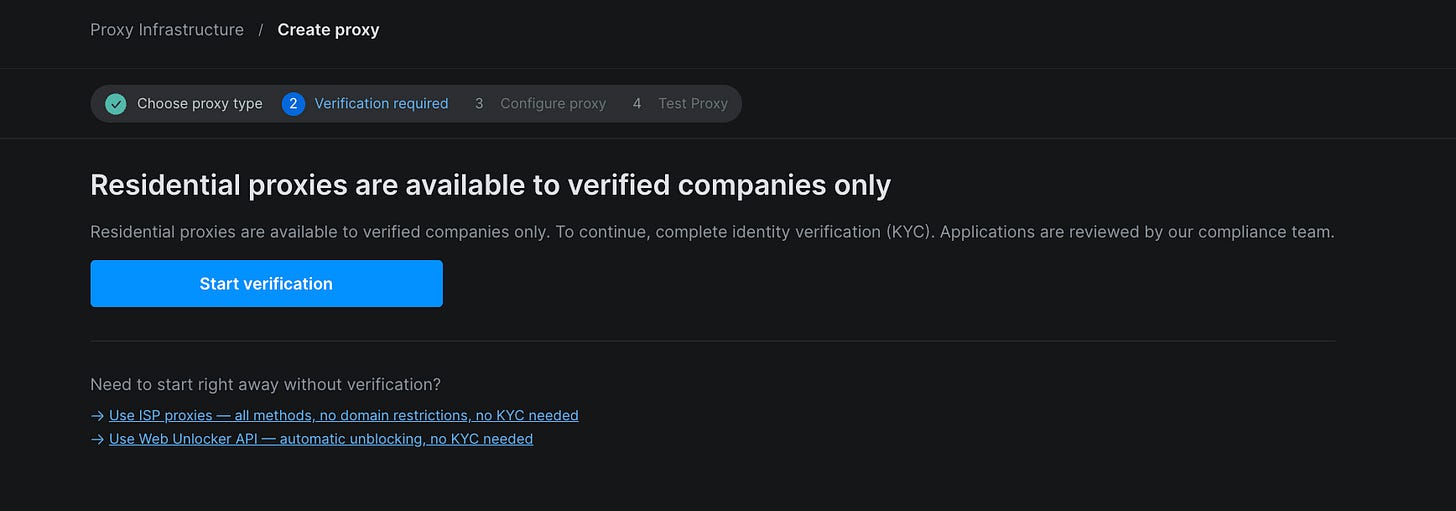
No more easy access to proxies: some companies have already restricted the usage of residential networks to customers who have already completed the KYC process.
Bright Data's new KYC screen for residential proxies
In this example, Bright Data is requiring KYC for using residential proxies. Until a few months ago, it was required only when targeting specific websites.
An interesting point of view about this situation can be read in an article from Jason Grad (Massive founder) on this Substack.
The need for data by AI, both for training and in real time, is fueling the industry revenues. But it’s not just a matter of money; it’s about being recognized as a crucial technology layer for every business that needs web data.
Another piece of good news comes from the legal side: Federal Court Grants SerpApi’s Motion to Dismiss Google’s DMCA Lawsuit. This is a major win for the web scraping industry, since “the court rejected Google’s attempts to expand the DMCA to assert control over access to public pages”.
The Napster era for content
I’m not saying anything new when I state that AI overviews and LLMs’ answers are crunching visits to websites (and, in some cases, hammering them with millions of requests for scraping them). Cloudflare recently announced that, by default, “for new customers and for new sites for existing customers, on September 15, 2026, the defaults will be set to allow for search but block training and agent use for pages with ads”.
The idea, which seems good on paper, is to make AI crawlers pay for data to compensate the publisher instead of scraping it. They already announced the Pay-per-crawl protocol some time ago, and this choice goes in the same direction.
We did the math some time ago, and it doesn’t make any sense. Those fees should be low enough to make it more convenient to pay instead of bypassing Cloudflare. This means that 99% of website owners won’t even notice the payment on their bank account.
I believe we’re entering the Napster era for online content. Premium content that we don’t want to be fully cannibalized by AI will be under a paywall. There will always be someone who pays for it and then shares it for free with others; it’s unavoidable, just like on Napster in the 2000s. Let’s call this unwanted marketing expenses.
Read and share more of this
Want to flag and discover more articles like the ones above? Scraping News (still in beta) is where the community surfaces them. Sign up and submit what you find worth reading.
Want a concept map of everything covered here, cross-referenced with our own work and other sources worth your time?