
5 mistakes that are driving up your scraping costs - Insights from DataImpulse
An in-depth look at the real factors driving up web scraping costs and how smarter proxy usage and system design can reduce expenses by up to 60%.
This is a guest post written by the DataImpulse team, tackling the problem behind the costs of scraping. For an independent benchmark of proxy prices, visit our Proxy Pricing Benchmark tool.
Every product has its own price, usually formed by a simple and predictable formula. Proxy services follow a similar pricing logic. At first thought, multiplying the proxy price by the amount of bandwidth should result in a final cost, but in fact, many aspects must be taken into consideration. Bandwidth is not a clean, one-to-one reflection of useful work. What users pay for is not just the data they properly collect but also everything that happens around. And it’s about request failures, encountered blocks, timeouts, and suboptimal routing decisions.
Much of the traffic in scraping systems is consumed without usable output, and that’s where the gap between expected and actual costs starts to widen. To understand where the budget really goes, we need to research it deeper.
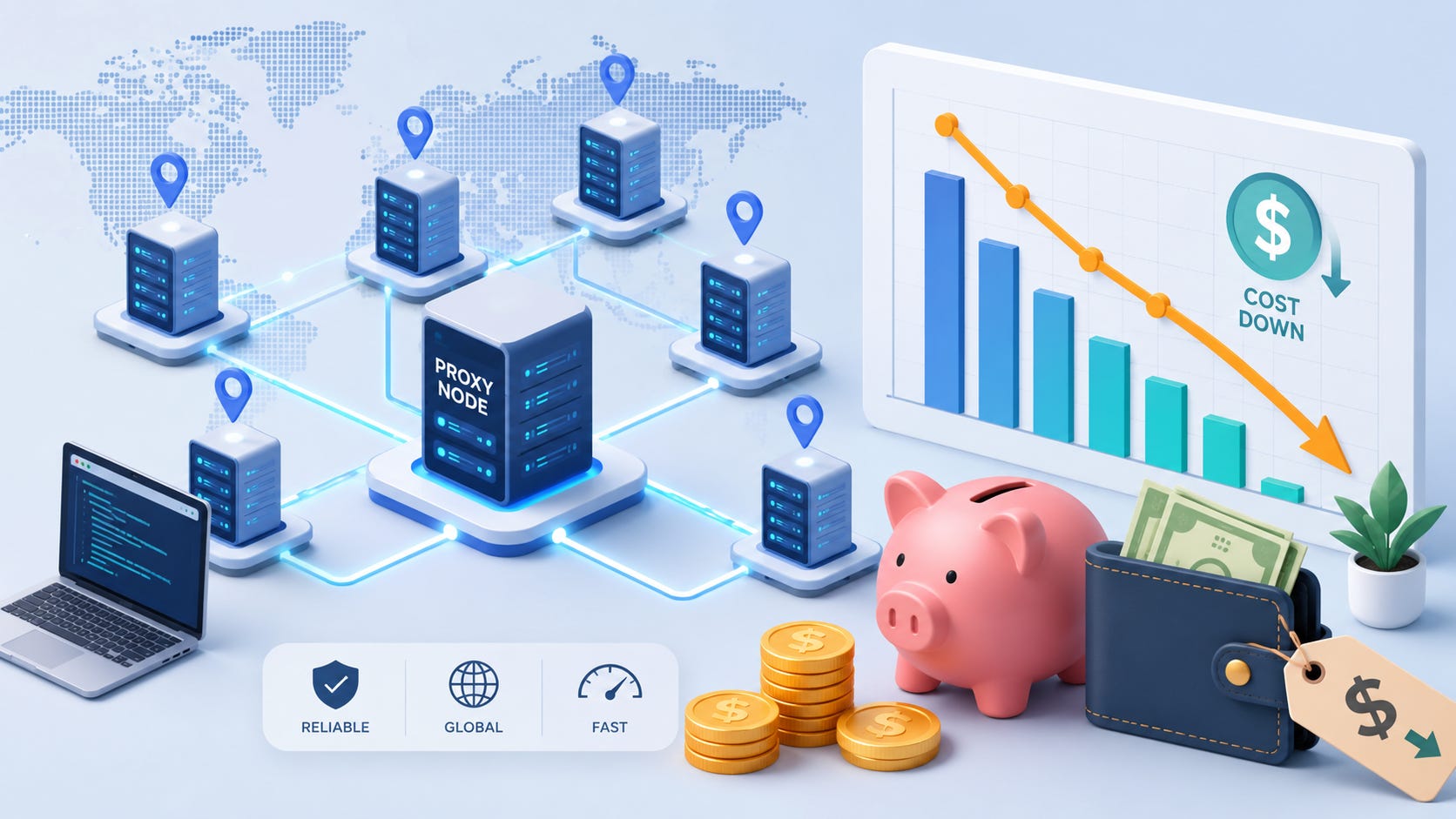
What is the math behind the scraping costs
Bandwidth is measurable, and proxy providers typically price it transparently. However, it’s not the key driver of the cost, it’s the result of a much more complex process. Each unit of bandwidth stands for a series of events, rather than merely one successful request. While some requests yield immediate data, many others can fail, be obstructed, time out, or require further attempts. Consequently, the actual cost structure is influenced more by system behavior than by the volume of traffic.
The real cost equals the total number of request cycles necessary to extract data multiplied by the cost of executing each request cycle. In simple words, it is defined by how many complete attempts the system must make before it gets that one response. The key detail is that only successful requests generate value. Each request cycle may have the initial request, retries after timeouts, proxy rotation, session management, and many other factors. All of them consume resources. Because of this, the real price increases not only when proxy prices rise but also when the system becomes less well-functioning. The same dataset can cost remarkably more to extract when the scraping pipeline is inefficient.
The cost amplification effect, known as the cumulative increase in resource usage caused by constant request cycles, is an issue in web scraping systems. One failed request can trigger multiple follow-up attempts. These extra cycles accumulate and raise the cost required to get one successful data point. For this reason, it’s accurate to evaluate scraping by cost per successful request. The fewer attempts needed, the lower the real cost.
Mistake #1 - Using the wrong proxy type
This mistake is not just widespread but can also cost you a lot. Not all targets need the same level of stability and anonymity, but numerous systems use a universal strategy. This results in either high costs or poor operation.
Each proxy type has its own balance of speed, cost, and detection resistance. The system will not work if that balance doesn’t align with the target website’s behavior. For example, mobile IPs are not just more expensive by default. They are highly trusted and harder to get blocked, so it’s logical to use them for challenging targets. When they are used on low-protection websites, they increase costs without improving the results. The approach that works is based on the right matching of proxy type to the task.
Residential proxies are actively used in web scraping as they route traffic via IPs assigned by ISPs to real devices. By looking like it comes from the real user, these proxies ensure strong trust signals. Many proxy users notice better success rates when they switch to residential IPs.
Mobile proxies direct traffic via carrier networks using IP addresses from mobile service providers. Since these IPs are shared, the traffic appears very authentic and is significantly more difficult for systems that rely on fingerprinting to identify.
Datacenter proxies function on cloud or server-based infrastructure and use IP ranges that aren’t tied to real ISPs. The biggest advantage is speed. They are perfect for heavy automation and data collection tasks.
Mistake #2 - The retry loop problem
The goal of retry logic is to improve success rates by giving failed requests another attempt to return a valid request. This approach works when responses are consistent, and failures are occasional, not systematic. On targets with rate limits or unstable responses, many retries can lead to constant failures under the same conditions. Not all failures are the same. If you got a timeout, it’s worth retrying, but if it’s a 403 error or a block, there are other actions to try. For example, you can rotate proxies or fix headers.
Retries can turn into a loop where the system keeps sending more requests but isn’t getting better results. Instead of retrying everything the same way, treat different errors differently, and adjust your behaviour based on the response. You can rotate proxies after getting a certain status code or stop retrying when a request is blocked.
Mistake #3 - Misconfigured proxy rotation
Rotating proxies aggressively is not a solution. Changing IPs too often makes traffic look unnatural and can raise suspicion. On the flip side, not rotating enough can create another issue. Thus, there must be balance. Some websites tolerate frequent IP changes, while others expect a more stable session. Treating all targets the same way is not appropriate. It’s better to adjust rotation based on the context.
If the server expects the same user behavior over time, using sticky sessions may help. In this case, it’ll help maintain session consistency and not break the flow. For bulk data extraction, you can try rotating proxies more frequently. In this situation, there is no need to preserve session context. You can also refine your rotation if you use signal-based triggers instead of fixed rules. Rotate thoughtfully, and when the system detects specific conditions like a sudden drop in success rates or status codes, adapt your proxy to it.
Mistake #4 - Ignoring caching and duplicate requests
A notable portion of scraping traffic is often dedicated to retrieving data that has already been collected. This occurs when pipelines lack deduplication or clear definitions for data freshness. It leads to repeated requests for identical resources. This process consumes bandwidth and proxy capacity without providing new information.
To address this, implement a caching layer and deduplication logic. Responses can be cached based on a time-to-live (TTL) interval that aligns with the frequency of data updates. Request fingerprints can be used to identify duplicates before requests are sent. For structured data, storing IDs or hashes of processed items allows the system to skip previously captured content.
Mistake #5 - No cost-aware proxy routing
Many scraping systems process all requests through a single proxy type. This approach can simplify implementation, but it can still lead to ineffectiveness. Different endpoints often have distinct requirements, and a universal strategy may result in unnecessary costs.
For instance, using proxies with a high trust score for simple endpoints can be expensive, whereas lower-cost proxies used for protected pages may result in blocks and required retries. Without routing logic to adapt to these variables, systems often overpay or underperform. They can’t adapt.
An alternative is to implement cost-aware routing, which matches the proxy type to the difficulty of the task. This involves using more economical options for low-risk requests and escalating to higher-trust proxies only when necessary. By monitoring metrics such as status codes, latency, and success rates, the system can determine when to switch proxy pools. For example, a blocked request can be retried using a higher-trust proxy rather than repeating the request under the same conditions.
This approach creates a more structured pipeline that balances cost and performance by allocating resources based on the specific requirements of each request.
Understanding the real price of proxies
While “price per GB” is often cited as a standard industry metric, experienced engineers understand that it fails to capture the true economic reality of data scraping. In practice, failed requests consume bandwidth and incur costs despite yielding no usable data. These unsuccessful attempts represent a negative return on investment.
Furthermore, the expenses associated with automated retries add another hidden expense. We have to look beyond the basic per-GB rate and adopt the “Cost Per Successful Request” (CPSR). This metric provides a more accurate reflection of true operational expenses.
To calculate the cost of each valid data retrieval, use the following formula:
CPSR = price per GB / 1,000 * 1 / Success Rate
In this equation, the “success rate” is the percentage of requests that return an HTTP 200 OK status along with the intended data. Organizations can make better financial decisions if they start evaluating proxy services through the lens of CPSR.
DataImpulse is a reliable provider of residential, mobile, and datacenter proxies with non-expiring traffic and a pay-as-you-go model, meaning purchased traffic remains available until it is used. This vendor offers more than 90 million IPs in 195 countries. Teams usually choose DataImpulse for web scraping, ad verification, market research, SERP monitoring, and website testing.
Why is DataImpulse cheaper than other vendors?
The pricing structure is based on the proxy sourcing method. Many providers purchase traffic rights from ISPs and resell them, which includes an additional markup. DataImpulse sources IP addresses directly through its own application and SDKs, bypassing intermediaries to avoid extra costs. This operational model complies with all legal standards.
How to reduce your scraping costs by 30-60%
Cost efficiency in data collection is primarily achieved by minimizing inefficient requests and increasing the success rate of each attempt.
To optimize expenses, match proxy types to the specific requirements of the task. Using cost-effective proxies for straightforward targets while reserving higher-trust proxies for more challenging endpoints can reduce unnecessary spending.
Refining retry logic is also important. Failures should be addressed based on their specific status codes. Avoiding repeat requests under identical conditions prevents the waste of resources.
Proxy rotation should be managed strategically rather than randomly. Implementing sticky sessions and rotating based on indicators such as blocks or elevated failure rates can improve both stability and overall success rates.
Incorporating caching and deduplication techniques helps manage traffic. By avoiding redundant requests for data that has not changed, it is possible to decrease total request volume.
Implement a cost-aware proxy routing strategy. Prioritize lower-cost alternatives, escalating to premium options only when strictly necessary. This approach facilitates a more efficient resource allocation model, ensuring that infrastructure investments are directed toward the areas of greatest impact.
Lastly, pay attention to how your scraper interacts with websites. When a browser loads a page, it also pulls images, scripts, videos, and even fonts. Thus, lots of traffic is generated. Use HTTP requests for structured data and browser-based scraping when JS rendering is necessary.
These optimizations don’t require a comprehensive system overhaul. Incremental improvements in request efficiency can harvest significant cost reductions.
Start measuring your current CPSR baseline
At first sight, scraping costs look like a simple equation between proxy price and bandwidth. But the real drivers of cost lie deeper. As we’ve seen, unnecessary retries and poor rotation strategies contribute to a growing gap between expected and actual costs. A system with low success rates will always consume more resources.
The important shift is moving away from thinking in terms of raw pricing and toward thinking in terms of efficiency. It doesn’t always require major steps, simple adjustments are key. Better proxy selection, cost-aware routing, caching, and improved retry logic are among them. From factual proxy usage data from DataImpulse, we’ve seen that even small optimizations can noticeably reduce total costs. Every request should add value, so spending must be thoughtful and deliberate. Audit your scraping pipeline against these 5 mistakes today.
How do i know that a request is strict or not, so that i can decide on which proxy to use.